
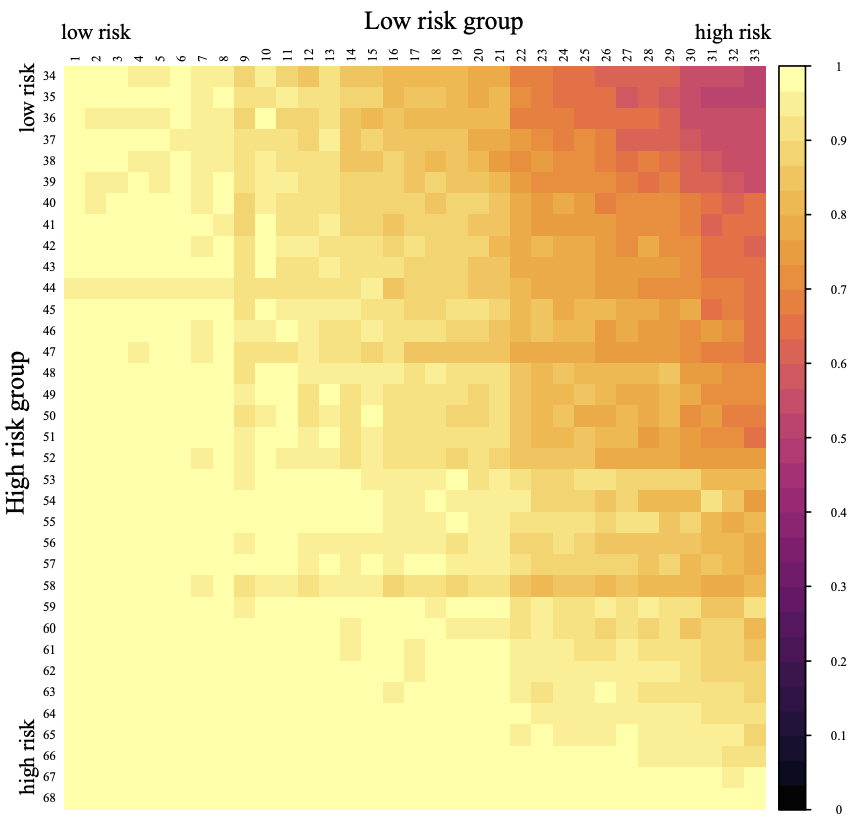
Few Bayesian methods for analyzing high-dimensional sparse survival data provide scalable variable selection, effect estimation and uncertainty quantification. Such methods often either sacrifice uncertainty quantification by computing maximum a posteriori estimates, or quantify the uncertainty at high (unscalable) computational expense. We bridge this gap and develop an interpretable and scalable Bayesian proportional hazards model for prediction and variable selection, referred to as SVB. Our method, based on a mean-field variational approximation, overcomes the high computational cost of MCMC whilst retaining useful features, providing a posterior distribution for the parameters and offering a natural mechanism for variable selection via posterior inclusion probabilities. The performance of our proposed method is assessed via extensive simulations and compared against other state-of-the-art Bayesian variable selection methods, demonstrating comparable or better performance. Finally, we demonstrate how the proposed method can be used for variable selection on two transcriptomic datasets with censored survival outcomes, and how the uncertainty quantification offered by our method can be used to provide an interpretable assessment of patient risk.
Variational Bayes for high-dimensional proportional hazards models with applications within gene expression
M. Komodromos, E.O. Aboagye, M. Evangelou, S. Filippi and K. Ray
Published: 25/06/2022
Published in:
Bioinformatics
Bioinformatics